

UPS Topology
Comparison
Evaluating Line-Interactive vs. Online Double Conversion technologies to safeguard your critical infrastructure.
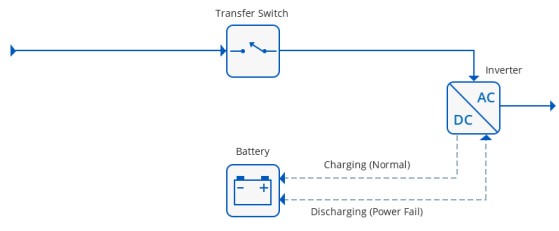
Line-Interactive UPS
Maintains the inverter in line and redirects the battery’s DC current path from normal charging to supplying current when power is lost. Offers additional filtering and yields reduced switching transients since the inverter is always connected to the output.
Protection
Sags, Surges, Voltage Spikes
Ideal For
Standard Business Systems
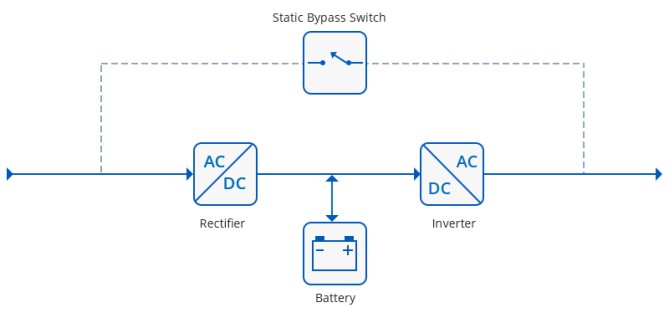
Online Double Conversion
Uses a "double conversion" method: rectifying AC to DC, then inverting back to pure AC. The input AC is always charging the battery, which feeds the output inverter, ensuring zero transfer time during power failure.
Protection
Total Line Isolation
Ideal For
Highly Critical Loads
Core Functions
Surge & Noise
Both suppress surges, but Online UPS offers superior isolation via double-conversion, shielding against EMI/RFI noise.
Transfer Time
Line-interactive takes 2-4ms. Online UPS has zero transfer time, as the inverter is already active.
Voltage Regulation
Line-interactive uses AVR (±8-15%). Online systems offer precise continuous regulation within ±2-3%.
Anomaly Protection Matrix
| Power Anomaly | Line-Interactive | Online |
|---|---|---|
| Power Failure | ||
| Power Sag | ||
| Power Surge | ||
| Under-Voltage | ||
| Over-Voltage | ||
| Electrical Line Noise | — | |
| Frequency Variation | — | |
| Switching Transient | — | |
| Harmonic Distortion | — |
Strategic Summary
The choice between topology depends on your business requirements. Highly critical loads inevitably require Online UPS topology due to its ability to protect sensitive data from mains problems at all times. This security often outweighs the extra cost, especially as modern hardware has become highly efficient.